
PIQSY Guide
Coffee Machine Cleaning and Upkeep: What Changes With Each Brewing System?
The maintenance job changes with the kind of machine you buy. A pod brewer avoids daily grinding and tamping but still requires water-system care and handling used pods. A drip-carafe machine adds a pot and grounds pathway. Manual espresso involves a portafilter, grinder if used separately, and a steam wand for milk. Automatic bean-to-cup reduces drink preparation work but still includes a grinder and milk-contact components to maintain. Do not choose a machine based on a fictional universal cleaning-time ranking; check its exact US manual for required frequency, products and disassembly instructions.
The decision this guide answers
Quick answer: The maintenance job changes with the kind of machine you buy.
Some shopping links may pay PIQSY a commission if you make a qualifying purchase. Editorial assessments remain independent. Affiliate disclosure
Quick answer: The maintenance job changes with the kind of machine you buy. A pod brewer avoids daily grinding and tamping but still requires water-system care and handling used pods. A drip-carafe machine adds a pot and grounds pathway. Manual espresso involves a portafilter, grinder if used separately, and a steam wand for milk. Automatic bean-to-cup reduces drink preparation work but still includes a grinder and milk-contact components to maintain. Do not choose a machine based on a fictional universal cleaning-time ranking; check its exact US manual for required frequency, products and disassembly instructions.
Start here: the quick answer
An easy morning coffee can still leave a messy machine. Pods mean used capsules; espresso means grounds and portafilter cleanup; milk drinks add parts that need careful attention. For dishwasher permissions, descaling products and cleaning intervals, read the manual for the exact US model rather than assuming every coffee maker follows the same routine.
What should you decide first?
Before choosing a coffee maker, list the tasks you are willing to repeat after every drink, each day and periodically. Are you comfortable washing a milk frother after each use? Will you remove used coffee grounds and clean a portafilter? Can you reach the water reservoir without moving the appliance? Do you want to maintain a separate grinder? These questions often decide long-term satisfaction more directly than a feature count. The information available for the models records key cleaning-relevant components but does not contain a complete, verified set of manufacturer instructions for every US variant. For this reason, the Guide explains categories of chores, not exact descaling intervals or dishwasher permissions for unverified models.
Which type fits you?
Single-serve K-Cup: Keurig K-Elite and K-Supreme Gen 2 make individual pod beverages; used capsules and water-system upkeep remain part of ownership. Check the exact model's manual for dishwasher permissions and descaling instructions; we don't have a verified schedule for every machine.
K-Cup plus milk: Keurig K-Café Barista Bar adds a separate hot/cold milk frother. Its source manual specifically identifies hand washing rather than dishwasher cleaning for the frother.
Dual pod and drip carafe: K-Duo Hot & Iced Gen 2 has two brewing pathways. With ground-coffee carafe use, expect additional handling of grounds and carafe components; exact cleaning instructions belong to its Gen 2 manual.
Manual espresso: Breville Bambino, Stilosa and CASABREWS manual machines involve an espresso portafilter and a manually operated milk wand. A separate grinder adds another component to manage.
Integrated and automatic: Barista Express, Pro and guided Brevilles have built-in grinders; Ninja ES701 also has a milk system. Eletta Explore EX:4 handles bean-to-cup beverages and hot/cold milk through dedicated systems. Automation of drink preparation is not automation of all cleaning.
The decisions that change your shortlist
Do used pods or used grounds create more work for you?
A K-Cup system makes portioning simple, but you still handle used capsules and manage the machine's water path. A drip carafe adds grounds and a vessel that needs cleaning after brewing. Neither should be declared universally cleaner without consistent observation of actual chores, local waste options and the manufacturer's instructions. Some people prefer handling a pod because it avoids a portafilter station; others prefer grounds because they already manage ground coffee. K-Duo Gen 2 gives you both paths, which can be useful for varied households but introduces more components. Before assuming dual-format is convenient, ask whether both brew modes will actually be used and who is responsible for cleanup.
How much extra work does milk bring?
Any milk-contact component requires appropriate attention because milk can remain on surfaces after use. A manual steam wand, separate frother and automated milk system are different implementations. K-Café Barista Bar's included separate frother has a source-supported hand-wash limitation. Breville Bambino and Barista Pro use manual steam wands; Touch Impress and Oracle Jet have Auto MilQ; Eletta Explore uses LatteCrema Hot and Cool systems. Each may have model-specific cleaning programs or removable parts, but this research has not independently confirmed those directions across the lineup. Do not write that one is dishwasher-safe, self-cleaning, free of milk residue or faster to maintain without reading the exact official manual. When choosing, count how often you make milk drinks and whether the cleanup feels acceptable.
Does an integrated grinder eliminate grinder care?
Putting the grinder inside the coffee machine removes a separate purchase, not the fact that it handles beans and coffee particles. Barista Express and Pro have source-described integrated burr grinders; standalone Bambino, Stilosa and CASABREWS models do not. If you pair a manual espresso machine with a separate grinder, consider where it sits, how you fill it and whether you can access the relevant parts for maintenance. An integrated grinder may centralize the station but can also make the whole machine the object of care. The current evidence does not provide reliable cross-model repair frequency, burr replacement schedules or service costs. Those should not be invented to justify one architecture over another.
What should you verify about descaling and water?
Water management matters for any machine, but the correct cleaning product, interval and procedure depend on the manufacturer's instructions and sometimes local water conditions. A large water reservoir does not remove the need to manage it, and a nominal tank size cannot tell you an exact time until descaling. We have some tank sizes—such as a 72 fl oz reservoir for K-Duo Gen 2—but not a consistent set of manufacturer descaling instructions across all fifteen candidates. The CASABREWS 3700 Essential manufacturer record even conflicts on exact tank capacity, so the number is deliberately left unknown. Read the specific US manual before using a chemical cleaner, taking parts apart or claiming compatibility with filters and accessories.
Can an automatic machine still require daily attention?
Yes. Fully automatic bean-to-cup machines reduce the manual steps for preparing drinks, while still containing coffee pathways, a grinder, a water system and possibly milk-contact components. Eletta Explore has hot and cold LatteCrema systems; the exact procedure for cleaning them must come from its EX:4 instructions, not general recollection of another De'Longhi model. Oracle Jet is more automated around a portafilter but still involves that architecture. If the reason you want automation is to avoid all contact with coffee parts, neither category promises that. Evaluate preparation convenience and maintenance work separately; the machine that is easiest to make a latte with is not automatically the easiest to clean.
Common buying mistakes
Inventing dishwasher-safe parts: The only explicit frother cleaning claim admitted here is the K-Café Barista Bar's hand-wash limitation; do not transfer it to other products.
Giving a universal descale interval: This requires the exact US manufacturer manual and may depend on water conditions.
Using tank capacity as a maintenance score: Capacity alone cannot establish cleaning frequency, and the CASABREWS 3700 Essential capacity is unresolved.
Equating one-touch preparation with no cleanup: Automated milk systems still have milk-contact parts.
Mixing manufacturer generations: A K-Duo Gen 2 procedure must not be copied from K-Duo Plus, nor EX:4 advice from an unverified Eletta revision.
Where should you go next?
If you mainly want low-effort one-cup coffee, compare K-Elite and K-Supreme on the drink controls you actually use. If you want a K-Cup frother, read the K-Café Barista Bar Verdict and verify the hand-wash instructions. If you want manual espresso, examine Bambino and Barista Express alongside the grinder setup Guide. If you want automatic milk and drinks, read Touch Impress, Oracle Jet and Eletta Explore while preserving the fact that a complete manufacturer-manual cleaning comparison has not been certified. We can't reliably say which machine takes the fewest minutes to clean or how often each needs descaling. Before buying, read the exact US manual and check which replacement parts or approved cleaning products you may need.
What we can confirm: No current verified USD offer or independent comparable cleaning-time, durability or flavor-performance test is available for these exact US machines. For safe cleaning and maintenance, follow the official instructions for your exact model instead of relying on a generic coffee-machine schedule.
Explore the products
Move from advice to the product details.
See the products discussed in this guide. Use the buying advice above to decide what fits your needs.

Keurig K-Café Barista Bar Single Serve Coffee Maker and Frother
US model: K-Café Barista Bar
Amazon.com · Checked Nov 3, 2026
You already like K-Cup pods and want milk drinks as part of the routine; You prefer a separate hot/cold frother to operating an espresso steam wand; You mainly prepare individual cups, rather than a pot for guests.
Trade-off: Its concentrated coffee shot is not portafilter espresso, and the frother needs its own care.
Paid link · PIQSY may earn a commission
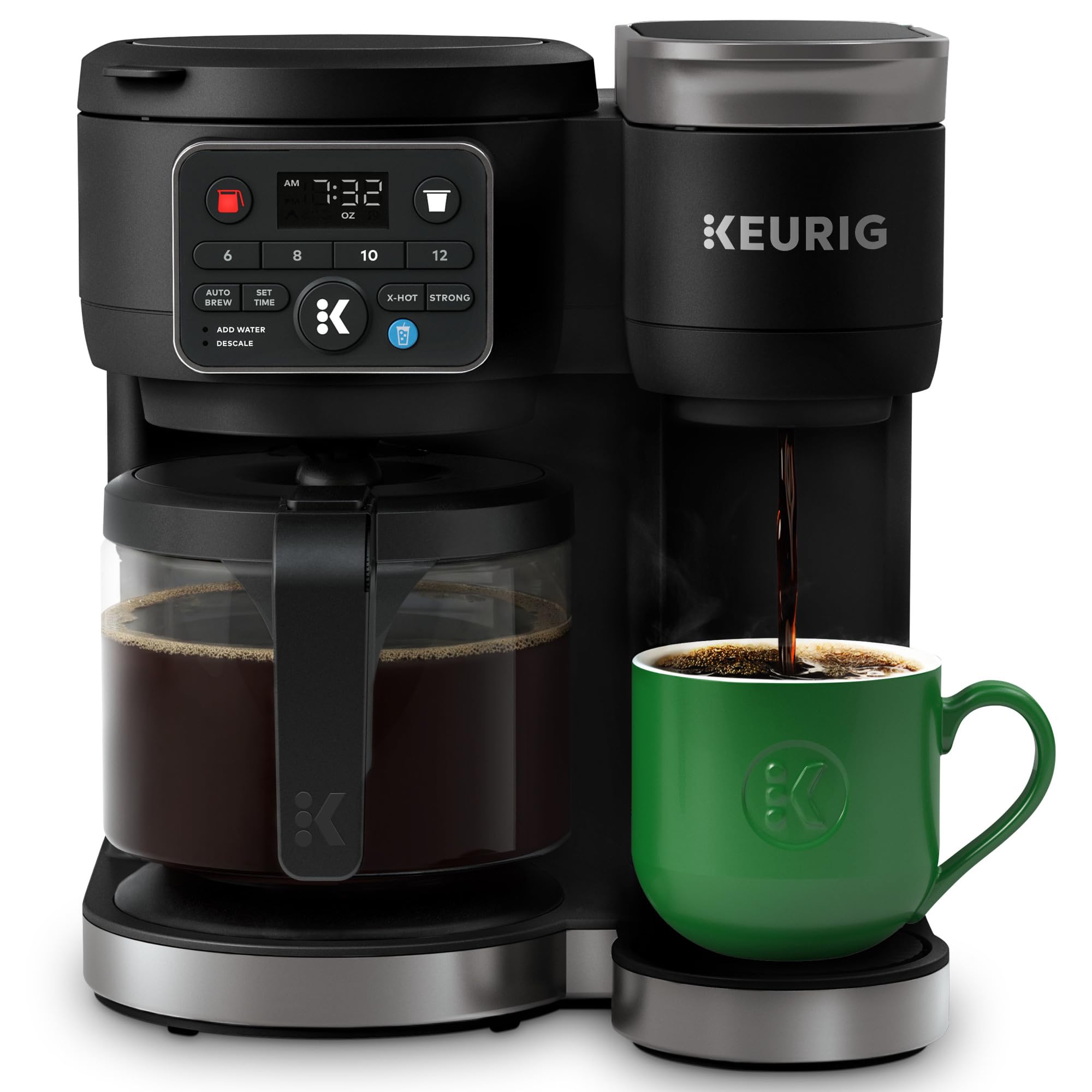
K-Duo Hot & Iced Gen 2
US model: K-Duo Hot & Iced Gen 2
Amazon.com · Checked Nov 3, 2026
You alternate between individual weekday cups and a full pot for several people; You want to use K-Cups sometimes and ground coffee for a carafe; You regularly brew over ice but do not need an espresso machine.
Trade-off: The carafe arrangement demands more counter space and still cannot make espresso.
Paid link · PIQSY may earn a commission

Breville Bambino BES450BSS
Amazon.com · Checked Nov 3, 2026
An espresso beginner who values a small machine; someone who already owns a suitable espresso grinder; a home coffee drinker who wants hands-on control without a built-in grinder.
Trade-off: The grinder, tamping technique and manual steam-wand practice remain your responsibility.
Paid link · PIQSY may earn a commission

Eletta Explore
US model: ECAM45086S
Amazon.com · Checked Nov 3, 2026
You want to avoid manually dosing and tamping a portafilter; You regularly make hot and cold milk-based coffee drinks; Integrated grinding and a guided one-touch drink menu fit multiple users.
Trade-off: A fully automatic beverage menu requires cleaning and ongoing system care while offering less manual puck control.
Paid link · PIQSY may earn a commission
Compare the closest choices
Move from the format to the actual product decision.
PIQSY Compare
Breville Barista Express BES870XL vs Breville Barista Pro BES878
Open comparison →PIQSY Compare
Breville Barista Pro BES878 vs Breville Barista Touch Impress BES881
Open comparison →PIQSY Compare
Breville Bambino BES450 vs Breville Barista Express BES870XL
Open comparison →PIQSY Compare
Keurig K-Café Barista Bar vs Keurig K-Elite Single Serve
Open comparison →PIQSY Compare
Keurig K-Duo Hot & Iced Gen 2 vs Keurig K-Supreme Gen 2
Open comparison →PIQSY Compare
Keurig K-Elite Single Serve vs Keurig K-Supreme Gen 2
Open comparison →Care and practical guidance
More guidance for this category.
Choose your coffee maker by the drink you make most often, the number of people you serve and the amount of work you want before each cup. K-Cup machines deliver quick single servings; a drip carafe makes more sense for several people; portafilter espresso involves grinding and puck preparation; and fully automatic bean-to-cup machines take over more of that process. None is a universal upgrade over another. If the brew format is wrong, an extra feature or attractive offer does not make the machine fit.
Do You Need a Separate Grinder for Espresso?A separate grinder is necessary for a fresh-bean setup when your espresso machine does not include one. Breville Bambino BES450, De'Longhi Stilosa EC260BK and the CASABREWS manual machines in this research have no built-in grinders. Breville Barista Express and Barista Pro include grinding, but their portafilter work and manual milk steaming remain hands-on. The right decision is not simply which machine costs less on its own. It is whether you want a flexible two-piece coffee station or a coordinated machine-and-grinder package.
Iced Coffee, Cold Brew and Cold Foam: Which Coffee Maker Feature Matters?"Iced coffee" can mean brewed coffee poured over ice, a rapid machine cold-coffee program, long-steeped cold extraction or a cold espresso-based drink. Cold foam is a milk preparation, not a brewing method. Those differences explain why a Keurig Brew Over Ice setting, Ninja Luxe Café Pro rapid cold brew, Breville Oracle Jet cold programs and De'Longhi Eletta Explore Cold Extraction Technology should not be treated as identical. Start with the drink you actually make, then ask whether you want hot coffee cooled over ice, a machine-specific cold process or automatic cold milk texture.
Our research approach
How to interpret the product details.
Our research approach
How to interpret the product details.