
PIQSY Compare
Solaris Max (2nd Gen.) vs Solaris Slim H2 (new)
Choose Solaris Max for a taller floor tower and detailed heat-mode controls; choose Slim H2 when its shorter 70-degree oscillating form better fits your room.
The choice that matters
Taller or More Compact?
The Solaris names sound like an obvious good/better ladder, but that is not what the evidence establishes.
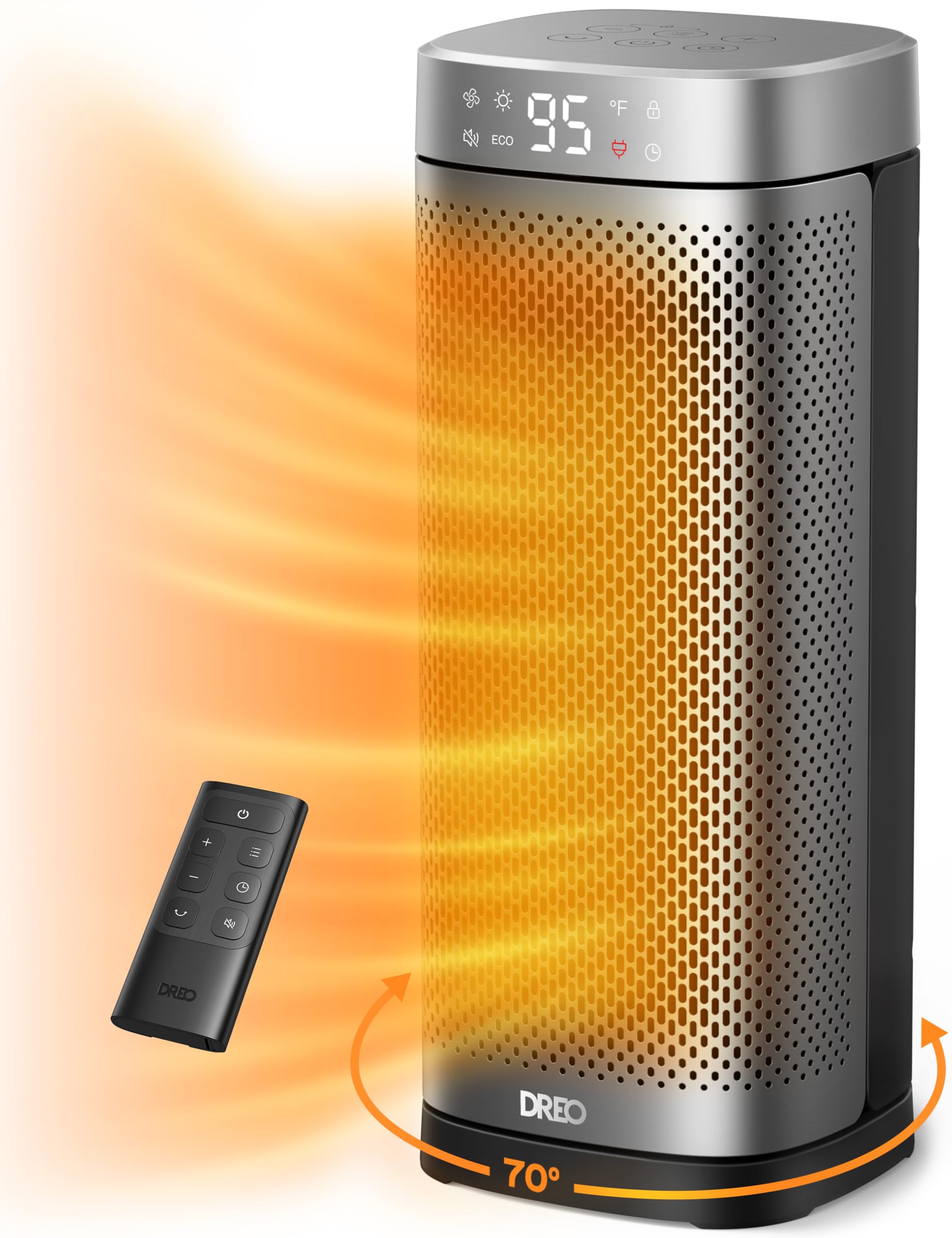
Product comparison
The two models
Product A
Solaris Max (2nd Gen.)
Best fit: Larger occupied floor space
Why choose it: Taller moving warm-air tower
Main trade-off: Needs more open floor height
Last checked price
Price not verified
Manufacturer range · check the exact model and availability
Product B
Solaris Slim H2 (new)
Best fit: Compact room layout
Why choose it: Shorter oscillating tower body
Main trade-off: Smaller heat outlet height
Last checked price
$69.99
Paid link · PIQSY may earn a commission
Some shopping links may pay PIQSY a commission if you make a qualifying purchase. Editorial assessments remain independent. Affiliate disclosure
What matters when choosing
Choose Solaris Max for a taller floor tower and detailed heat-mode controls; choose Slim H2 when its shorter 70-degree oscillating form better fits your room.
The Solaris names sound like an obvious good/better ladder, but that is not what the evidence establishes. Both are ceramic fan heaters with digital temperature controls, up to 1,500 watts of rated input and 70-degree oscillation. The Solaris Max (2nd Gen.) stands roughly 26.8 inches high and provides an expanded set of operating modes. Solaris Slim H2 is approximately 16 inches high, using a smaller vertical body. Your floor layout and how you'll adjust the heater matter more than the implication that Max must heat a room faster.
What you'll actually notice
Max's tall air outlet changes where the warm stream originates. Slim H2 is shorter and may fit a compact occupied area more naturally, assuming safe manufacturer-approved placement. Both oscillate through a 70-degree range rather than offering the Tower 718's much wider selectable pattern. If all you want is warm air on one stationary desk chair, either may be more complicated than a fixed-direction heater. Neither has an independently established absolute quietness or heating-speed advantage.
What changes the choice
Will extra height improve your setup?
A taller tower can place the warm air stream closer to the seating level when it stands on the floor. That may be useful in a living room, but it also creates a larger appliance near pets, children or furniture. The shorter Slim H2 may feel easier to position in an office, provided the manufacturer permits that location and the unit has enough space around it. Measure an open placement with clearances, not simply the footprint. It is wrong to squeeze either unit between curtains and a couch because it appears narrow.
Is the 70-degree swing essentially the same job?
Both advertise 70-degree oscillation, so the basic aim is similar: alternate warm airflow across a limited occupied zone. The Max's higher case does not turn 70 degrees into 120 degrees or give it a proven ability to raise room temperature faster. If you need more direction choices, the Dreo Tower Heater 718 has selectable sweep angles up to 120 degrees and is the more meaningful comparison. If one or two nearby chairs are the job, the Slim's existing sweep may be completely adequate.
Do the operating modes justify the Max?
Solaris Max (2nd Gen.) lists H1, H2, H3, ECO and fan-only options, digital temperature control and a remote. Slim H2 also has high/low-style selections, a fan mode, one-degree temperature adjustment and a remote. Max's more detailed operating package can help if you like switching between settings during the day, but it won't appeal to someone who wants one familiar temperature. The 41°F–95°F thermostat range is a target setting, not a promise that the window-side chair will match the number on screen.
Is either model measurably quieter or cheaper?
The Max's own product descriptions conflict on claimed sound levels, so it would be misleading to promise it is the quieter heater. Both can draw 1,500 watts at maximum according to the available manufacturer specifications; an uninterrupted full-power hour therefore corresponds to about 1.5 kWh. At an example $0.20 per kWh that is 30 cents, before lower modes or thermostat cycling. Neither has a verified heater-to-heater electricity-saving lead. Choose by usable controls and physical fit instead of a noise or heating speed slogan.
How do you keep either choice practical and safe?
The CPSC advises keeping a portable electric heater at least three feet from combustible materials, using a suitable direct wall outlet rather than a power strip or extension cord, and switching it off before leaving the room or going to sleep. Follow any stricter model manual. That applies to oil-filled radiators as much as ceramic towers. Tip-over, thermostat and timer features don't remove burn or fire risks. If there is no open, stable place for the heater and its cord, don't force either appliance into a crowded corner.
The practical choice
If the heater will stand beside an open living-room seating area, the Solaris Max's taller outlet and extra modes may be useful. In a smaller occupied space, Slim H2 already provides the same 70-degree type of sweep without the taller cabinet. Measure a safe location first, then decide whether the extra height earns its place.
When to choose Dreo Solaris Max (2nd Gen.)
Choose Solaris Max (2nd Gen.) if you have safe floor space and will genuinely use its taller outlet, remote and different heating modes. Verify the specific second-generation model rather than transferring details from older Solaris products.
When to choose Dreo Solaris Slim H2
Choose Slim H2 if the shorter body and its 70-degree oscillation address the occupied space without needing a larger tower. Match the exact DR-HSH014 product label and do not confuse it with another similarly named Dreo heater.
Choose neither when
A Dreo Ceramic Heater 316 makes more sense for one fixed seat. A fanless radiator better fits people who dislike moving warm air. Neither tower should be operated while sleeping or placed in a busy walkway or against combustible materials.
PIQSY conclusion
Choose Solaris Max for a taller air outlet and detailed settings; choose Solaris Slim H2 if its shorter 70-degree tower fits better beside your seating area. You don't need extra height just to warm a small occupied spot. Check the safe floor location first; neither is proven to heat every room faster.
Final comparison
Which fits your priorities?
Product A
Solaris Max (2nd Gen.)
Choose when: The Dreo Solaris Max (2nd Gen.) is built around the idea that a space heater should be easy to adjust while you move around a frequently occupied room.
Read Verdict →Product B
Solaris Slim H2 (new)
Choose when: The Dreo Solaris Slim H2 (new) makes sense if you like the idea of a compact space heater but need its warm air to reach more than one seat.
Read Verdict →Product details
Model details
See available model specifications
| Detail | Solaris Max (2nd Gen.) | Solaris Slim H2 (new) |
|---|---|---|
| US model | Solaris Max (2nd Gen.) | Solaris Slim H2 (new) |
| Brand | Not recorded | DREO |
| Special Feature | Not recorded | 1-12h Timer, 41-95℉Adjustable Digital Thermostat, ECO Mode, Fast Heating, Oscillating |
| Color | Not recorded | Silver |
| Form Factor | Not recorded | Tower |
| Indoor/Outdoor Usage | Not recorded | Indoor |
| Special Features | Not recorded | 1-12h Timer, 41-95℉Adjustable Digital Thermostat, ECO Mode, Fast Heating, Oscillating |
| Indoor Outdoor Usage | Not recorded | Indoor |
| Power Source | Not recorded | Corded Electric |
| Heating Method | Not recorded | Forced Air |
| Recommended Uses For Product | Not recorded | Bedroom, Home, Living Room, Office |
| Mounting Type | Not recorded | Floor Mount |
| Room Type | Not recorded | Bedroom, Dining Room, Home Office, Kitchen, Living Room |
| Heating Coverage | Not recorded | 107.6 – 215.3 sq.ft. |
| Heating Element | Not recorded | PTC |
| Heat Output | Not recorded | 1500 watts |
| Fuel Type | Not recorded | Electric |
| Number of Speeds | Not recorded | 3 |
| Voltage | Not recorded | 120 volts |
| Amperage | Not recorded | 16 A |
| Min Temperature Setting | Not recorded | 41 °F |
| Max Temperature Setting | Not recorded | 95 °F |
| Brand Name | Not recorded | DREO |
| Model Number | Not recorded | DR-HSH014 |
| Number of Items | Not recorded | 1 |
| Item Highlight | Not recorded | 1500W Fast Heating, Quiet Operation, Remote Control, 12H Timer, ECO Mode, Digital Thermostat and Shield360° Safety |
| Unit Count | Not recorded | 1 Count |
| Warranty Description | Not recorded | 24h Customer Servies;1-year warranty as standard and 5-year warranty extended chance |
| UPC | Not recorded | 810142851725 |
| Manufacture Year | Not recorded | 2024 |
| Included Components | Not recorded | 1 × DREO PTC Space Heater (DR-HSH014), 1 × Remote Control (Includes 1 X CR2025 Battery), 1 × User Manual |
| Item Type Name | Not recorded | Space Heater |
| Manufacturer | Not recorded | DREO |
| Part Number | Not recorded | DR-HSH014 |
| Item Dimensions D x W x H | Not recorded | 6.38"D x 6.1"W x 15.83"H |
| Item Weight | Not recorded | 5.1 pounds |
| GTIN | Not recorded | 810142851725 |
Source: exact-US retained listing observations (latest checked 11/3/2026). Check current configuration with the manufacturer; these are not comparative performance tests.
Keep comparing
Related comparisons worth checking.
Dreo Solaris Slim H2 vs Tower Heater 718: Small Tower or Wider Sweep?
Both Dreo models provide ceramic forced-air heating, a digital thermostat and oscillation, so it's easy to assume the bigger heater is simply better.
Dyson HP2 De-NOx vs Dreo Solaris Max: Do You Need an Air Purifier Too?
The Dyson Purifier Hot+Cool HP2 De-NOx and Dreo Solaris Max are not substitutes at the same product job.
Our research approach
How to interpret the product details.
Our research approach
How to interpret the product details.