
PIQSY Compare
Midea MAP12S1TBL vs Dreo AC740S
The real choice is what your room makes difficult: Midea has stronger independent evidence for quiet, efficient cooling; Dreo is worth considering when its smaller cabinet and installation kit fit your room better.
The choice that matters
Quieter Cooling or a Smaller Footprint?
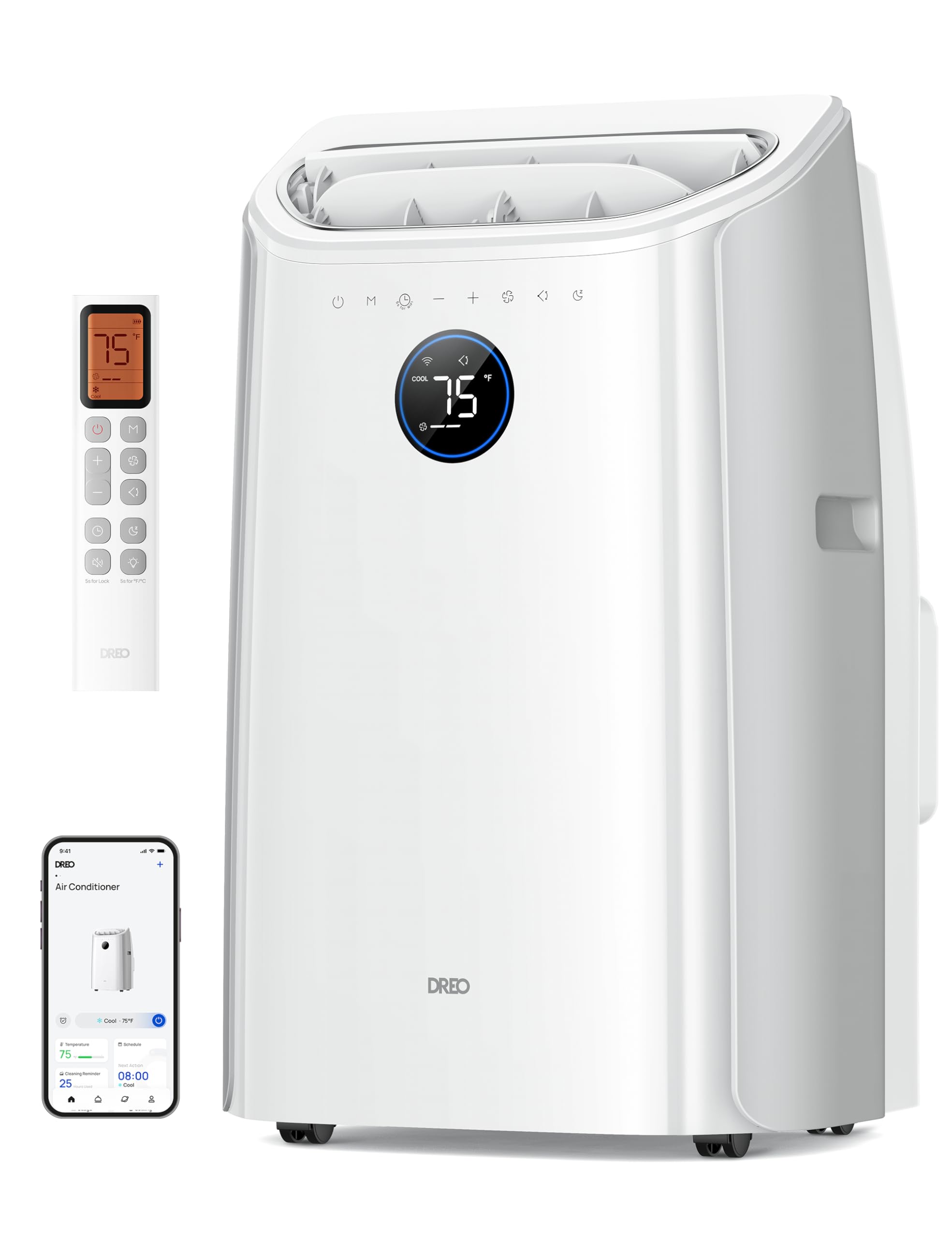
Product comparison
The two models
Product A
Midea MAP12S1TBL
Best fit: Medium-room cooling with nighttime sound concerns
Why choose it: Independent comparisons favor quieter lower-setting fan operation
Main trade-off: Its larger cabinet may be harder to fit in tight rooms
Last checked price
Price not verified
Paid link · PIQSY may earn a commission
Product B
Dreo AC740S
Best fit: Vent-compatible rooms where physical space is tight
Why choose it: A smaller cabinet and documented window-kit fit range
Main trade-off: Independent low-setting noise results are less favorable than Midea's
Last checked price
$699.99
Paid link · PIQSY may earn a commission
Some shopping links may pay PIQSY a commission if you make a qualifying purchase. Editorial assessments remain independent. Affiliate disclosure
What matters when choosing
The real choice is what your room makes difficult: Midea has stronger independent evidence for quiet, efficient cooling; Dreo is worth considering when its smaller cabinet and installation kit fit your room better. Both are 10,000-BTU DOE dual-hose inverter portables. Neither is the automatic answer if your real problem is an unsuitable window.
The choice that matters
Choose Midea for independently tested efficiency and quieter cooling.
Choose Dreo when cabinet space and window-kit fit matter more.
Best fit — Midea: A medium-sized living space or bedroom where power consumption during cooling, temperature stability and fan noise have real daily consequences. Biggest reason: Better tested efficiency and quietness in RTINGS' comparison. Main compromise: A bulky cabinet that may be inconvenient in a crowded room.
Best fit — Dreo: A room where floor space and a documented 20–53-inch window-kit range help determine what can actually be installed. Biggest reason: More compact physical packaging with smart controls. Main compromise: Its drainage-free and low-noise marketing needs conditions attached, and independent testing does not establish an overall efficiency win.
What you'll actually notice
When the room is hot, both machines aim to do a similar job. Their 10,000-BTU DOE ratings place them in the same nominal cooling class; the higher ASHRAE numbers on the product pages come from a different standard and do not indicate an additional cooling mode. Both use inverter compressors and a two-hose airflow arrangement that separates outdoor intake from exhaust.
The biggest independent difference is not a flashy feature. RTINGS finds the Midea Duo MAP12S1TBL better than the Dreo 740S overall, with more efficient cooling and temperature maintenance and quieter fan operation, particularly at lower settings. These are outcomes observed under the review site's testing conditions, not measurements we performed or a guarantee of identical behavior in every room.
Dreo has a more compact body. That is genuinely useful if you have a narrow gap beside the window or simply dislike giving up as much of a living room to an appliance. But footprint comparisons must include hose routing and air clearances. A compact body squeezed into a position that blocks airflow does not become a good installation.
What changes the choice
Is nighttime sound the deciding factor?
For a bedroom, a unit that produces less fan noise at the setting you use can be more important than a headline BTU figure. RTINGS' specific comparison supports Midea here: the Midea's fan is significantly quieter than the Dreo's at lower settings. That is a meaningful reason to lean toward it if the AC will run near your bed or during calls.
The important qualification is that neither model is silent. Inverter compressors can make variable mechanical noises; RTINGS notes occasional chattering on the Midea. Sound at your pillow depends on machine position, set temperature, floor vibration, room acoustics and fan speed. A manufacturer-claimed lowest dBA figure does not describe the sound while tackling peak afternoon heat.
Switch when: If comparable test noise and bedroom comfort are your priority, start with Midea. If physical placement makes the Midea impractical, see whether the Dreo actually fits before considering it an alternative.
Does the cabinet fit without turning your room into an obstacle course?
Dreo lists cabinet dimensions of approximately 17.32 inches wide, 14.37 inches deep and 28.11 inches high. RTINGS characterizes it as noticeably smaller than Midea. In a small apartment living room, a few inches can determine whether you can move past a sofa without shuffling sideways.
Dreo also publishes a 20–53-inch window height range for its included kit. That's a useful specification to check against your measured opening, but not proof that the product fits every frame style within those numbers. Sliding tracks, latches, wall clearance and hose bends can still cause problems.
The Midea's two-in-one hose system also needs a sealed window installation. Confirm its current kit instructions for your window rather than assuming the Dreo range applies to both. If your only opening cannot be vented safely, neither is suitable.
Switch when: Choose Dreo if the Midea cannot be installed neatly but the Dreo's documented hardware and dimensions solve that specific problem. Don't select Dreo just because smaller sounds more convenient.
What does efficiency change once the room is cool?
An inverter compressor can ease back its output once the target temperature is reached instead of repeatedly switching on and off at full power. That helps explain why both are more interesting than basic fixed-speed portables for longer cooling sessions. It does not prove that every inverter unit has the same energy use.
RTINGS reports that Midea is more power-efficient at both cooling and maintaining the chosen temperature than Dreo. That is relevant if you run the unit for many hours, but not permission to promise a particular monthly bill saving. Local electricity prices, thermostat settings, window sealing and the room's heat gain will determine the actual cost.
Switch when: If both units physically fit and are available at reasonable comparable prices, the evidence favors Midea for tested efficiency. If Midea is much more expensive or difficult to source, evaluate the actual delivered-price difference rather than inventing one.
Do you want app control, or just a cooler room?
Both models provide smart-control options. Dreo supports app, touch-panel, remote and voice controls; Midea offers app and remote operation as well. Those functions can be convenient for adjusting the temperature from a couch, especially if the controls are on the far side of furniture.
Before treating the app as a tie-breaker, check the features and ecosystem you intend to use. Does the scheduler run the way you want? Is the household comfortable with an app account? Do you care about voice commands at all? Neither machine will become more effective because you downloaded another app.
Switch when: Consider the device whose exact controls simplify your daily routine. Otherwise, prioritize cooling, installation and total cost over another menu of connected options.
Will you have to drain it?
Dreo describes the 740S as drainage-free in environments below 90% humidity. Its own troubleshooting guide still describes a water-full protection state requiring the collection tray to be drained. That is a conditional convenience claim, not a promise of maintenance-free operation through a humid summer.
Midea also removes moisture during cooling. For both, practical water management depends on settings and conditions. Check access to the drain before installing a large cabinet behind a couch or desk, and follow the manufacturer's instructions for dry mode and seasonal storage.
Switch when: Don't choose Dreo solely to avoid drainage. Choose based on a verified installation, then plan for the moisture handling the operating instructions require.
The practical choice
If both machines fit and you care about long cooling sessions, begin with Midea because independent testing supports its relative efficiency and quietness. If space is the limiting factor and the Dreo's dimensions and window kit offer a real installation advantage, Dreo earns consideration even without a lab-score win.
Do not use either model's ASHRAE figure to compare against a different product's DOE/SACC figure. And don't treat an online star average as reliable proof of exact-model durability when individual review origins and variants have not been screened.
When to choose Midea Duo MAP12S1TBL
Choose Midea when a medium room needs substantial cooling, a compatible window is available, and you value independently measured temperature stability, fan noise and power use. It is the more defensible choice when all those conditions matter and the delivered offer is competitive.
A Midea product page may show direct-store unavailability while a US retailer lists the exact model. Check condition, seller, shipping and return terms rather than assuming the product has disappeared nationwide.
When to choose Dreo Portable Air Conditioner 740S
Choose Dreo if you have verified that the Midea's cabinet or kit will not work conveniently and Dreo's smaller body and 20–53-inch window kit solve the issue. It also makes sense if you prefer its particular control layout and the actual offer makes the compromise worthwhile.
Keep expectations realistic: Dreo's advertised 42 dBA minimum and under-90%-humidity drainage statement are manufacturer conditions, not universal operating results.
Choose neither when
Neither is suitable if hot air cannot be vented outdoors, the electrical installation cannot meet the manufacturer's safety instructions, or your space is a large open-plan area beyond a single machine's reasonable cooling role. For a heavier heat load, investigate a verified higher-capacity model such as Whynter ARC-1230WN. For a genuinely small shaded room, a simpler 5,000- or 6,000-BTU LG may be sufficient.
PIQSY conclusion
Choose Midea for the stronger independently tested quietness and efficiency case. Choose Dreo only when its smaller footprint, kit fit or confirmed offer changes the practical choice. Both need a compatible venting window, accessible drainage and realistic room sizing. An attractive sound number on a product page won't fix a bad installation. We also don't have enough reliably screened reviews from owners of either exact model to settle the choice on durability.
Final comparison
Which fits your priorities?
Product A
Midea MAP12S1TBL
Choose when: A medium room with meaningful afternoon heat gain; a renter who needs portable compressor cooling but has a vent-compatible window; a buyer who wants inverter operation and app-based controls.
Main advantage: Its dual-hose inverter setup is relevant when cooling efficiency and maintaining comfort matter more than buying the smallest appliance.
Trade-off: A large floor-standing body and specialized venting hardware make setup and storage more involved than the name “portable” suggests.
Read Verdict →Product B
Dreo AC740S
Choose when: A medium room with a compatible window, a buyer who values phone or remote controls, and someone comparing the physical fit of several dual-hose inverter designs.
Main advantage: A 10,000-BTU DOE inverter/dual-hose design packaged with a documented 20–53-inch window kit and multiple control methods.
Trade-off: The manufacturer has numerous attractive claims, but published humidity and noise conditions deserve careful reading; it is not the highest SACC capacity model in this shortlist.
Read Verdict →Product details
Model details
See available model specifications
| Detail | Midea MAP12S1TBL | Dreo AC740S |
|---|---|---|
| US model | MAP12S1TBL | AC740S |
| Brand | Not recorded | DREO |
| Capacity | Not recorded | 241 cubic feet |
| Cooling Power | Not recorded | 14000 british thermal units |
| Special Feature | Not recorded | 42 dB Quiet Working Noise Level, Drainage-Free, Dual-Hose, Fast Cooling, Inverter High Energy Efficiency See more |
| Product Dimensions | Not recorded | 14.37"D x 17.32"W x 28.13"H |
| Color | Not recorded | White Inverter |
| Voltage | Not recorded | 115 volts |
| Noise Level | Not recorded | 42 db |
| Refrigerant | Not recorded | R-32 |
| Power Source | Not recorded | Corded Electric |
| Additional Features | Not recorded | 42 dB Quiet Working Noise Level, Drainage-Free, Dual-Hose, Fast Cooling, Inverter High Energy Efficiency |
| Noise | Not recorded | 42 db |
| Inverter Type | Not recorded | Has Inverter |
| Installation Type | Not recorded | Packaged |
| Air Conditioner Application | Not recorded | Residential |
| Wattage | Not recorded | 1540 watts |
| Item Dimensions D x W x H | Not recorded | 14.37"D x 17.32"W x 28.13"H |
| Item Weight | Not recorded | 55.4 pounds |
| Window Opening Maximum Width | Not recorded | 53 inches |
| Window Opening Minimum Height | Not recorded | 20 inches |
| Window Opening Maximum Height | Not recorded | 53 inches |
| Floor Area | Not recorded | 200 square_feet |
| Room Type | Not recorded | Bedroom, Living Room |
| Brand Name | Not recorded | DREO |
| Model Name | Not recorded | DR-HAC010S White |
| Model Number | Not recorded | DR-HAC010S White |
| Unit Count | Not recorded | 1 Count |
| Included Components | Not recorded | 1 x DREO Portable Air Conditioners (DR-HAC010S), Window Panel×4、Air Exhaust Hose×2、Drain Hose、Remote Contro、Other installation components |
| UPC | Not recorded | 810142857208 |
| Manufacturer | Not recorded | DREO |
| Item Type Name | Not recorded | Portable Air Conditioners |
| Warranty Description | Not recorded | 12-MONTH LIMITED WARRANTY |
| Annual Energy Consumption | Not recorded | 1540 watts |
| Control Method | Not recorded | App, Remote |
| Controller Type | Not recorded | App Control, Remote Control |
| Operating Mode | Not recorded | Cooling |
| Warranty Type | Not recorded | Limited |
| Form Factor | Not recorded | Portable |
| GTIN | Not recorded | 810142857208 |
Source: exact-US retained listing observations (latest checked 11/3/2026). Check current configuration with the manufacturer; these are not comparative performance tests.
Keep comparing
Related comparisons worth checking.
Midea Duo MAP12S1TBL vs Whynter ARC-1030WN: which 10,000-BTU portable AC should you buy?
These two portable air conditioners are far closer than their different brand names suggest.
Whynter NEX ARC-1230WN vs Midea Duo MAP12S1TBL
The decision is less about the logos than the room: more rated cooling capacity for a tougher space or a lower-capacity dual-hose inverter that may be enough for ordinary medium-room cooling.
Our research approach
How to interpret the product details.
Our research approach
How to interpret the product details.