PIQSY Compare
Airmega 400S vs Blue Pure 211i Max
Choose Blueair Blue Pure 211i Max if strong, clearly specified particle airflow is your first priority.
The choice that matters
Which large-room purifier fits?
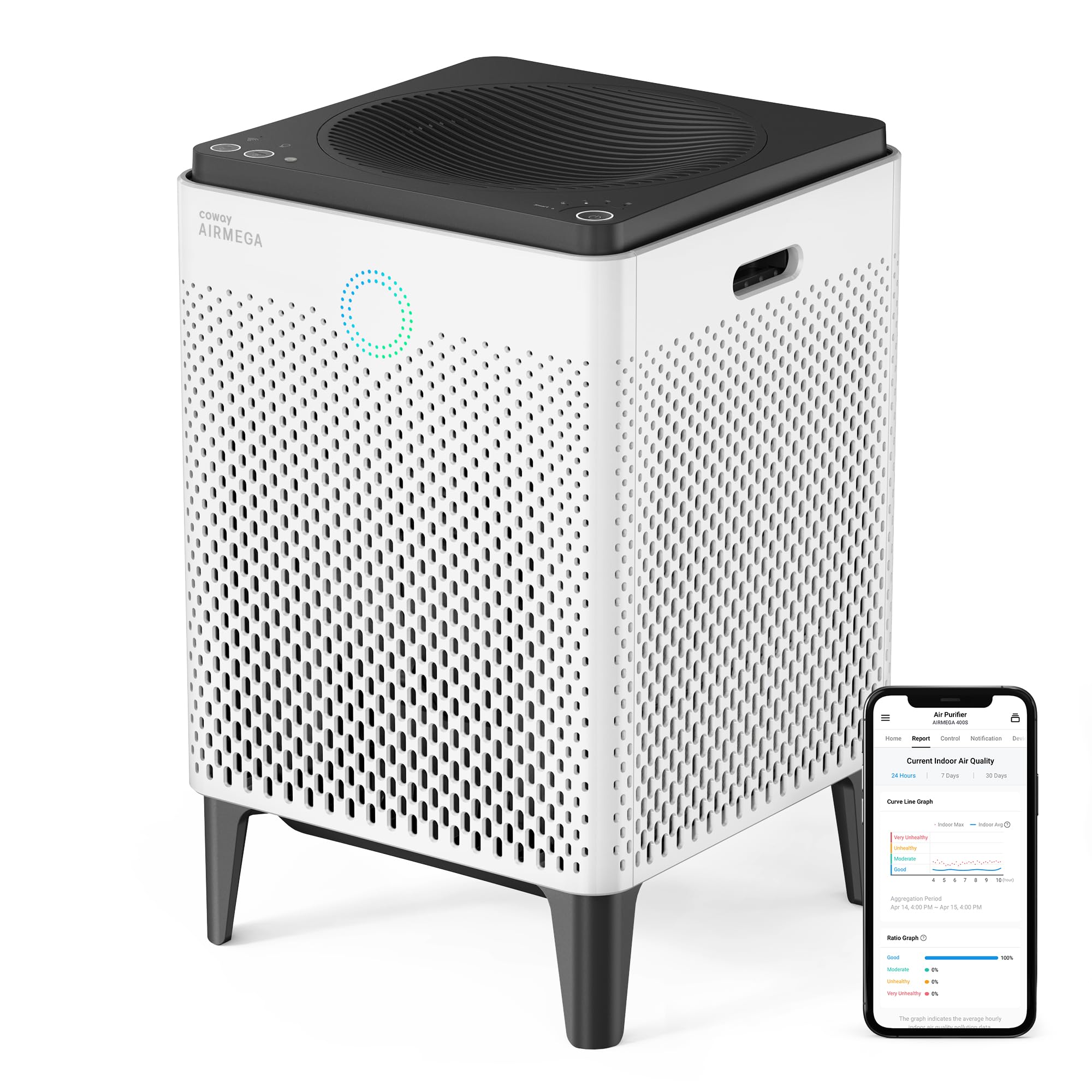
Coway reports 328 CFM smoke CADR for Airmega 400S and 1,560 square feet at two air changes per hour.

Product comparison
The two models
Product A
Airmega 400S
Best fit: Large rooms with Coway smart controls
Why choose it: Connected operation and Max2 filter routine
Main trade-off: Large area headline uses two ACH
Last checked price
$612.00
Paid link · PIQSY may earn a commission
Product B
Blue Pure 211i Max
Best fit: Large living rooms requiring more flow
Why choose it: Higher smoke CADR at high turnover
Main trade-off: Larger body and independent filter system
Last checked price
$349.00
Paid link · PIQSY may earn a commission
Some shopping links may pay PIQSY a commission if you make a qualifying purchase. Editorial assessments remain independent. Affiliate disclosure
What matters when choosing
Choose Blueair Blue Pure 211i Max if strong, clearly specified particle airflow is your first priority. Consider Coway Airmega 400S when its connected controls and Max2 filter routine are more compelling and its rated airflow fits the room. A common trap in this matchup is assuming Coway has substantially more usable coverage because its advertised square-foot number is larger.
Coway reports 328 CFM smoke CADR for Airmega 400S and 1,560 square feet at two air changes per hour. Blueair lists 435 CFM smoke CADR and 674 square feet at 4.8 ACH for the 211i Max. The Blueair has the higher published smoke delivery figure. The room area labels cannot be ranked directly because the air-turnover assumptions differ.
Start with the room, not the app
If your actual task is reducing particles in a large, enclosed living room, Blueair's 435 CFM manufacturer smoke CADR provides a useful starting point for capacity. Its 674-square-foot reference at 4.8 ACH is intended to describe relatively frequent equivalent air cleaning in a defined room.
Coway's Airmega 400S can also be relevant to large rooms, particularly if you like its appliance format and connected user experience. The Max2 filter ecosystem may be familiar if you already own a Coway. But its 1,560-square-foot claim uses two ACH, a substantially slower equivalent clean-air turnover than Blueair's 4.8. A bigger number does not make it a stronger high-turnover purifier.
Measure the room volume, including ceiling height. A living room open to a stairwell, dining room or kitchen may have more air to process than the floor plan suggests. If you need useful cleaning across separate zones, two properly placed machines may be more realistic than one unit in the far corner.
Are the published CADRs comparable?
The two numbers are both reported as manufacturer smoke CADR, making them more helpful for an initial airflow-class decision than the differing area labels. Blueair's 435 CFM is higher than Coway's 328 CFM. This doesn't prove a specific reduction in particles in your home, and it doesn't say which machine moves more air at an identical, tolerable noise level.
Neither value is a hands-on result from this article. A lab measurement made with a different particle type or filter setting should not be silently substituted for the manufacturer's smoke CADR. The existing independent test record for the non-S Airmega 400 does not automatically apply to the Airmega 400S with Wi-Fi. Exact configurations matter.
Blueair's selected retailer color and accessory package also deserve verification before using the precise results of any test of another family configuration. Model-family facts can help shoppers, but they aren't proof of identical retail bundles.
Will the quieter choice clean enough air?
Coway lists a 22–52 dB noise range. Blueair lists 23–53 dB. Those minimum and maximum figures don't establish a winner at the same airflow. The quietest setting generally provides less delivery than the maximum capacity used for room-size calculations.
Picture a family movie night. You may turn either fan down to hear the dialogue, and that can reduce how much air it moves. A high-capacity purifier might still clean effectively at a gentler setting, but only comparable airflow-and-noise evidence can prove that for these two models. Don't assume the biggest maximum rating also wins on quiet use.
Where you position the machine matters too. Keep the intake and outlet free of furniture, fabric and walls at the clearance recommended by the manufacturer. An attractive spot that restricts airflow can undermine either model.
Filter ownership: two unrelated systems
Coway's 400S uses a Max2 filter system, with an official 400/400S replacement-set reference. Blueair's 211i Max requires its genuine Particle + Carbon filter, with a model-level replacement reference of approximately nine months. The parts are different, and there is no reason to expect them to share cleaning or replacement instructions.
Check current genuine filter prices and package contents at a reputable seller. Neither the frozen dated cost records nor an unverified current appliance listing establish a fair all-in annual price ranking. The right question is what it costs to keep the unit operating over several years, not which box has the smaller sale tag.
Coway publishes 66 watts and Blueair 46 watts as model-level power specifications. These aren't measured annual household bills; electricity use depends on speeds, hours and local rates. If you'll operate the purifier for long periods, include the real settings and filter maintenance in your budget.
What smart features change
Airmega 400S is the connected variant, not the non-Wi-Fi Airmega 400. Its controls may help maintain a routine, but an app does not overcome an undersized machine. Blueair has its own control experience and replacement ecosystem; compare the actual features you're likely to use rather than counting app icons.
Sensors and particle readouts are not exhaustive measurements of chemical gases, strong odors or infection risk. Both machines primarily serve an airborne-particle job. Address ongoing smoke, moisture and fume sources directly, using appropriate ventilation.
Who should buy which?
Choose Blue Pure 211i Max if your room needs the higher 435 CFM manufacturer smoke CADR and the large-room role fits your space. Consider Airmega 400S if 328 CFM is adequate and its Max2 maintenance and connected controls suit your habits. Neither can be called a verified current-price bargain without exact US offer and filter data.
For an even more design-led high-flow option, Blue Signature Large is worth evaluating; for another connected large-room machine, consider Levoit Core 600S-P. Avoid oversizing for a small bedroom.
PIQSY conclusion
Blueair has the stronger published maximum smoke airflow in this pair. Coway provides a different connected and filter-ownership proposition. Do not treat Coway's 1,560 square feet at two ACH as a direct win over Blueair's 674 square feet at 4.8 ACH. Verify exact model, filter and US retailer details before buying; the Airmega 400 and 400S must remain separate.
Final comparison
Which fits your priorities?
Product A
Airmega 400S
Choose when: Consider the Airmega 400S if you have a relatively large, mostly continuous living space and care about a substantial appliance, smart control, and ongoing filter management.
Read Verdict →Product B
Blue Pure 211i Max
Choose when: Choose the 211i Max if airborne particle reduction in a relatively large, regularly occupied room is the main assignment.
Read Verdict →Product details
Model details
See available model specifications
| Detail | Airmega 400S | Blue Pure 211i Max |
|---|---|---|
| US model | Airmega 400S | Blue Pure 211i Max |
| Color | White | White/ Slate |
| Brand | Coway | Not recorded |
| Product Dimensions | 14.8"D x 14.8"W x 22.8"H | 14.4 x 14.4 x 22.7 inches; 3.97 pounds |
| Power Source | Corded Electric | Corded Electric |
| Item Weight | 24.7 pounds | 1.8 kg |
| Control Method | Voice | App |
| Filter Type | HEPA Filter, Active Carbon Filter, Pre-Filter | Activated Carbon |
| Floor Area | 3120 square_feet | 3234.75 square_feet |
| Noise Level | 22 db | 23 db |
| Particle Retention Size | 0.3 micron | 0.1 micron |
| Controller Type | Amazon Alexa, Vera | Amazon Alexa, Android, Button Control, iOS |
| Wattage | 66 watts | 46 watts |
| Contaminant Filtration Capability | Dust, Odors, Pet Dander, Pollen, Volatile Organic Compounds (VOCs) | Viruses, smoke, pet dander, pollen, mold, dust |
| Special Features | Air Quality Monitor, Eco Mode, Filter Life Indicator, Smart Mode, Wi-Fi Enabled | Corded |
| Filter Class | HEPA | HEPASilent |
| Software Update Supported to Date | unknown | unknown |
| Item Dimensions D x W x H | 14.8"D x 14.8"W x 22.8"H | 14.4"D x 14.4"W x 22.7"H |
| Specification Met | CARB Certified, ETL Certified | AHAM Certified |
| Brand Name | Coway | BLUEAIR |
| Model Number | Airmega 400S | Blueair 211i max |
| Model Name | Airmega 400S | Blue Pure |
| UPC | 826439150006 | 689122023045 |
| Global Trade Identification Number | 00826439150006 | Not recorded |
| Number of Packs | 1 | 1 |
| Unit Count | 1 Count | 1 Count |
| Manufacturer | Coway | Blueair |
| Warranty Description | 5 year manufacturer's limited warranty | Not recorded |
| Included Components | Air Purifier, Filter Set, User Manual | Air purifier, pre installed-filter, washable fabric pre-filter |
| Item Type Name | HEPA Filter Air Purifier | Air Purifier |
| Part Number | AP-2015E | 109556 |
| GTIN | 826439150006 | Not recorded |
| Item model number | Not recorded | Blueair 211i max |
| Date First Available | Not recorded | November 21, 2022 |
| Item Highlight | Not recorded | WiFi, Auto Mode, Quiet 23dB HEPASilent Filtration, AHAM Verified, Washable Pre-Filter, Captures Pet Hair Allergens Dust Smoke |
Source: exact-US retained listing observations (latest checked 11/3/2026). Check current configuration with the manufacturer; these are not comparative performance tests.
Keep comparing
Related comparisons worth checking.
Blueair Blue Pure 211i Max vs. Winix 5500-2: bigger-room airflow or simpler upkeep?
The manufacturer sources support different ways of describing these machines.
Blueair Blue Pure 211i Max vs. 311i Max: which size belongs in your room?
Blueair's US manufacturer specifications report 435 CFM smoke CADR and 674 square feet at 4.8 air changes per hour for the 211i Max.
Winix 9800 vs. Blueair Blue Pure 211i Max: connected cleaning or bigger rated airflow?
Blueair reports 435 CFM manufacturer smoke CADR and 674 square feet at 4.8 ACH.
Our research approach
How to interpret the product details.
Our research approach
How to interpret the product details.