
PIQSY Compare
Oil-filled Radiator 153 / DR-HSH033 vs Oil-filled Radiator 310 / OH310
Choose the Radiator 153 if you want classic fanless heat with simple knobs.
The choice that matters
Do you want simple knobs or remote-controlled radiator heat?
Both are oil-filled Dreo radiators built for supplemental heating in an occupied room.
Product comparison
The two models
Product A
Oil-filled Radiator 153 / DR-HSH033
Best fit: Fanless manual radiator use
Why choose it: Basic two-knob operation
Main trade-off: No remote thermostat
Last checked price
$94.99
Paid link · PIQSY may earn a commission
Product B
Oil-filled Radiator 310 / OH310
Best fit: Remote-controlled radiator use
Why choose it: Digital thermostat and off timer
Main trade-off: More settings to manage
Last checked price
Price not verified
Some shopping links may pay PIQSY a commission if you make a qualifying purchase. Editorial assessments remain independent. Affiliate disclosure
What matters when choosing
Choose the Radiator 153 if you want classic fanless heat with simple knobs. Choose the Radiator 310 if you want a digital temperature setting, timer and remote without switching to a fan-driven heater. Neither has a verified efficiency advantage simply because it uses a different control system.
Both are oil-filled Dreo radiators built for supplemental heating in an occupied room. Their main difference is how you manage the warmth: the 153 has two physical knobs and the 310 adds finer electronic controls. If you have room for an oil-filled radiator and prefer not to hear a fan, both offer a similar general comfort style.
What you'll actually notice
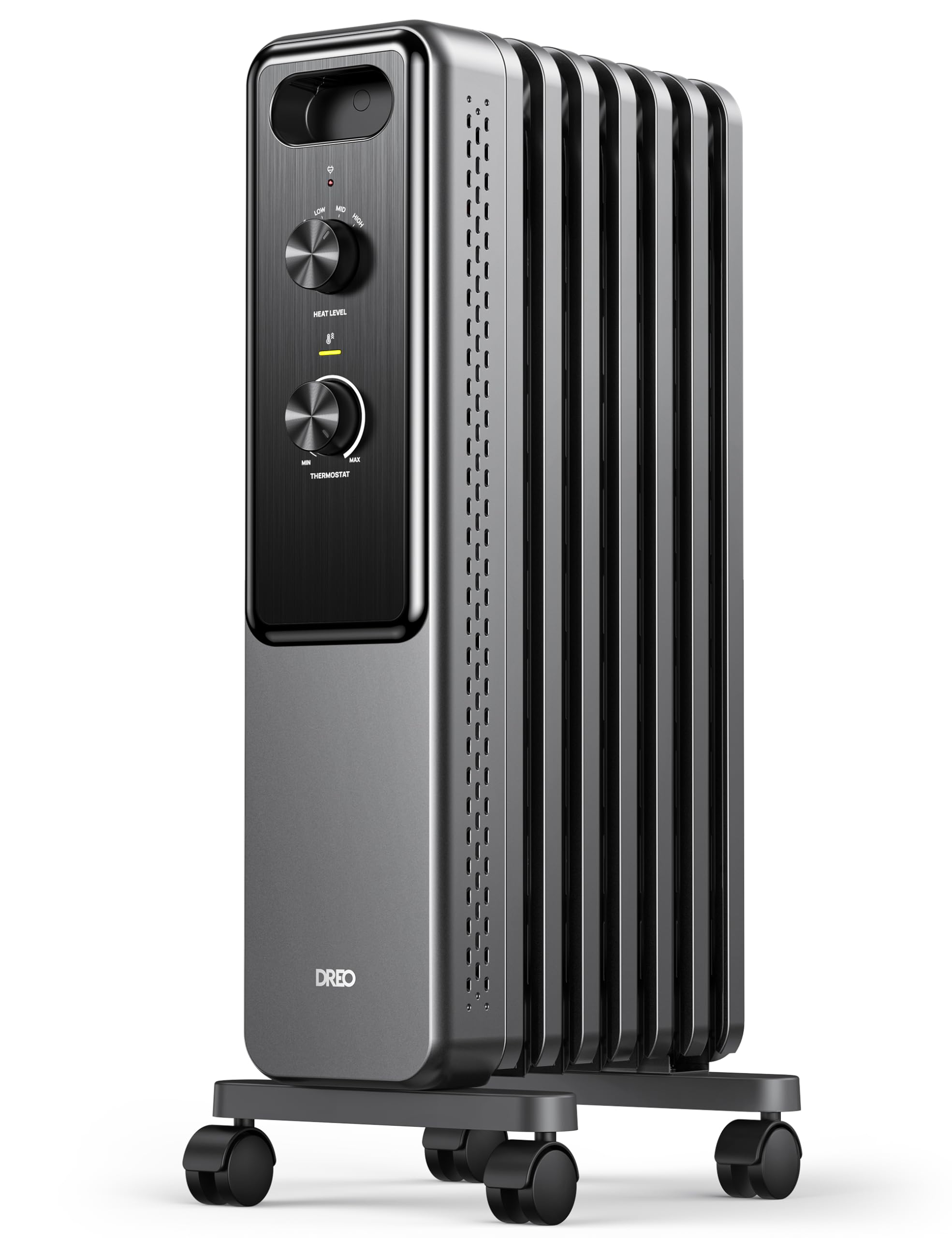
The Radiator 153 is the one to reach for when you want to turn a dial and move on. You select a heat level and thermostat position at the heater itself. The metal body gradually warms and transfers heat into the surrounding area. There is no app or remote to learn.
The Radiator 310 still uses sealed oil and metal fins, but it adds a display, remote, selectable heating modes and a timer. If the radiator sits safely away from the sofa, that may be more convenient because you can make adjustments without approaching a warm metal body.
Neither turns on and immediately produces the same sensation as a ceramic tower blowing heated air toward your chair. Both take time to warm up. The choice between them is about control convenience, not an independently measured thermal-performance winner.
What changes the choice
Do the two knobs save time or limit control?
The 153's mechanical controls are straightforward. You are unlikely to need instructions simply to choose more or less heat. This can make it feel less complicated in a room where you use the heater at roughly the same time each day.
The 310 has a digital interface and remote. That makes it easier to repeat a selected target temperature or adjust the heater while seated across the room. It also offers more operating choices to understand.
Think about how you actually operate a heater. If you set a temperature once for a supervised afternoon and rarely change it, the 153 does the job with fewer controls. If several people adjust the heater or conditions change throughout the evening, the 310's remote may earn its place.
What are the actual heat-setting differences?
Dreo lists a 1,500-watt maximum for each model. The 310's digital settings include 600, 900 and 1,500 watts and an ECO mode, while the 153 provides a more basic selection through its manual knobs. The 310 also offers a 41°F–95°F digital thermostat and a timer selectable up to 24 hours.
That does not mean the 310 is a more powerful radiator at its maximum setting. Both can draw 1,500 watts. The digital model simply makes it easier to choose a particular lower output or temperature target.
If you want the exact degree shown on a display, choose the 310. If you are happy adjusting by feel, the 153 may be simpler. A displayed target is still not a guarantee that every corner of the room has reached that temperature.
Is the 310's ECO mode a genuine savings advantage?
An automatic thermostat can cycle heat instead of drawing maximum power continuously. That is useful, but it is not a reason to believe the 310 produces more heat per unit of electricity than the 153.
At uninterrupted 1,500-watt input, either model can use 1.5 kWh in an hour. At an illustrative $0.20 per kWh, that equals around $0.30 for that full-power hour. Actual cost changes with cycling, settings, runtime and your electricity tariff.
A lower power setting can reduce energy use during a given hour, but it also supplies less heat. Do not compare energy use between the two without considering whether they are delivering sufficient comfort. Dreo's manufacturer energy-savings percentages are not substitute evidence for an independent, same-method household comparison.
How important is the timer for a radiator?
The 310's timer offers a useful way to define the end of a supervised heating period. You might choose a few hours while reading or working and then let the heater turn itself off, rather than remembering to walk over.
The 153 does not provide the same electronic scheduling package. With its physical controls, you should plan to switch it off yourself before leaving the room.
The distinction is convenience, not permission to operate unattended. The CPSC recommends turning portable heaters off when leaving or sleeping, even when they have a timer, thermostat and protective shutoff. A radiator's quiet operation also does not justify using it all night.
What does the physical radiator format require?
Both need a stable floor location with enough clearance around hot metal surfaces. These are not objects to hide behind a curtain or roll into a narrow passage while operating. Turn off and cool a radiator before moving it.
The 153 has a straightforward seven-fin design and weighs around 17.9 pounds according to Dreo. The 310 is another full-height radiator with wheels, so neither should be assumed to occupy the same usable space as a small ceramic desktop heater.
The CPSC recommends at least three feet from materials that can burn, with power supplied directly from a wall outlet rather than an extension cord or power strip. A safe floor location and cord path are more important than the number of digital settings.
Do the safety features settle the comparison?
Dreo describes overheat and tip-over protections for both product lines. These are manufacturer-reported safeguards. They do not prevent all possible burn or fire risks, nor have we independently matched both exact US units to a certification-directory listing.
The two models should not be confused with Dreo's DR-HSH015 heater recall. The exact manufacturer number on the unit and any production-date code are what matter when checking a safety notice.
Neither has a qualified sample of distinct exact US owner reports sufficient to establish a reliable defect-rate or longevity winner. A store's averaged star rating is not the same as independent analysis of comparable ownership experiences.
The practical choice
The simple distinction is knobs versus remote and detailed thermostat control. If you like an oil radiator because it is uncomplicated and fanless, the 153 fits that idea. If you want the same broad heat-delivery style but value repeatable temperature settings and a timer, choose the 310.
When to choose the Oil-filled Radiator 153
Choose the 153 when you prefer simple manual controls, will generally use the radiator from one location, and do not need to adjust it frequently from across the room. It can also suit someone who dislikes adding another remote to the household.
Don't choose it for an unsupported claim of superior longevity or lower electricity consumption. Its advantage is simplicity.
When to choose the Oil-filled Radiator 310
Choose the 310 for 600/900/1,500-watt settings, digital temperature selection, remote and timed operation. Those features make the most sense in a safely placed living room where settings change while people remain seated.
Don't choose it because the display or ECO mode automatically makes the radiator more efficient than every other heater.
Choose neither when
Neither fits a room where there is no open floor position, where bedding or curtains cannot remain clear, or where the only outlet requires an extension cord. If you need instant focused air at a desk, a ceramic heater has a different comfort profile. If you need heat running while asleep or away, consider an appropriate permanent heating solution.
PIQSY conclusion
Choose Radiator 153 if you like simple knobs; choose Radiator 310 if you'll regularly use its digital settings and remote. Think about whether you're happy to get up to adjust a heater during an occupied evening. Both offer gradual fanless warmth, and neither has a proven electricity-to-heat efficiency edge. Safe floor clearance and supervision still come first.
Final comparison
Which fits your priorities?
Product A
Oil-filled Radiator 153 / DR-HSH033
Choose when: The Dreo Oil-filled Radiator 153, identified as DR-HSH033, makes sense for people who dislike a fan blowing warm air around their room.
Read Verdict →Product B
Oil-filled Radiator 310 / OH310
Choose when: The Dreo Oil-filled Radiator 310, also called the OH310, suits someone who wants supplemental warmth without listening to a heater fan or feeling a stream of air on their face.
Read Verdict →Product details
Model details
See available model specifications
| Detail | Oil-filled Radiator 153 / DR-HSH033 | Oil-filled Radiator 310 / OH310 |
|---|---|---|
| US model | Oil-filled Radiator 153 / DR-HSH033 | Oil-filled Radiator 310 / OH310 |
| Brand | DREO | Not recorded |
| Special Feature | Energy Efficient, Overheat Protection, Tip-Over Protection | Not recorded |
| Color | Gray | Not recorded |
| Form Factor | Oil Filled Radiator | Not recorded |
| Indoor/Outdoor Usage | Indoor | Not recorded |
| Special Features | Energy Efficient, Overheat Protection, Tip-Over Protection | Not recorded |
| Indoor Outdoor Usage | Indoor | Not recorded |
| Power Source | ac | Not recorded |
| Heating Method | Radiant | Not recorded |
| Recommended Uses For Product | Garage, Greenhouse, Home, Office | Not recorded |
| Mounting Type | Floor Mount | Not recorded |
| Room Type | Bedroom, Home Office, Kids Room, Living Room, Study Room | Not recorded |
| Heating Coverage | 250 sq.ft. | Not recorded |
| Heating Element | Radiant | Not recorded |
| Heat Output | 1500 watts | Not recorded |
| Fuel Type | Electric | Not recorded |
| Number of Speeds | 3 | Not recorded |
| Voltage | 120 volts | Not recorded |
| Amperage | 12.5 A | Not recorded |
| Min Temperature Setting | 41 °F | Not recorded |
| Max Temperature Setting | 95 °F | Not recorded |
| Brand Name | DREO | Not recorded |
| Model Number | DR-HSH033 | Not recorded |
| Number of Items | 1 | Not recorded |
| Item Highlight | Dual Knobs, Energy Saving, 8 Safety Protection, 1500W Quiet Oil Filled Radiator for Bedroom, Adjustable Thermostat, Grey | Not recorded |
| UPC | 810142857994 | Not recorded |
| Included Components | 1 x DREO Oil Filled Heater(DR-HSH033), 1 x User Manual, 1 x Quick Start Guide | Not recorded |
| Item Type Name | Radiator Heater | Not recorded |
| Manufacturer | DREO | Not recorded |
| Part Number | DR-HSH033 | Not recorded |
| Item Dimensions D x W x H | 12.83"D x 9.92"W x 26.14"H | Not recorded |
| Item Weight | 17.9 pounds | Not recorded |
| GTIN | 810142857994 | Not recorded |
Source: exact-US retained listing observations (latest checked 11/3/2026). Check current configuration with the manufacturer; these are not comparative performance tests.
Keep comparing
Related comparisons worth checking.
De'Longhi Dragon vs Dreo Radiator 153: Is the Timer Worth It?
De'Longhi Dragon TRD40615T-6A and Dreo Oil-filled Radiator 153 both deliver gradual warmth without the constant airflow of a ceramic fan heater.
Dreo Tower Heater 718 vs Oil-filled Radiator 310
The models look different because they solve slightly different comfort problems.
Our research approach
How to interpret the product details.
Our research approach
How to interpret the product details.