
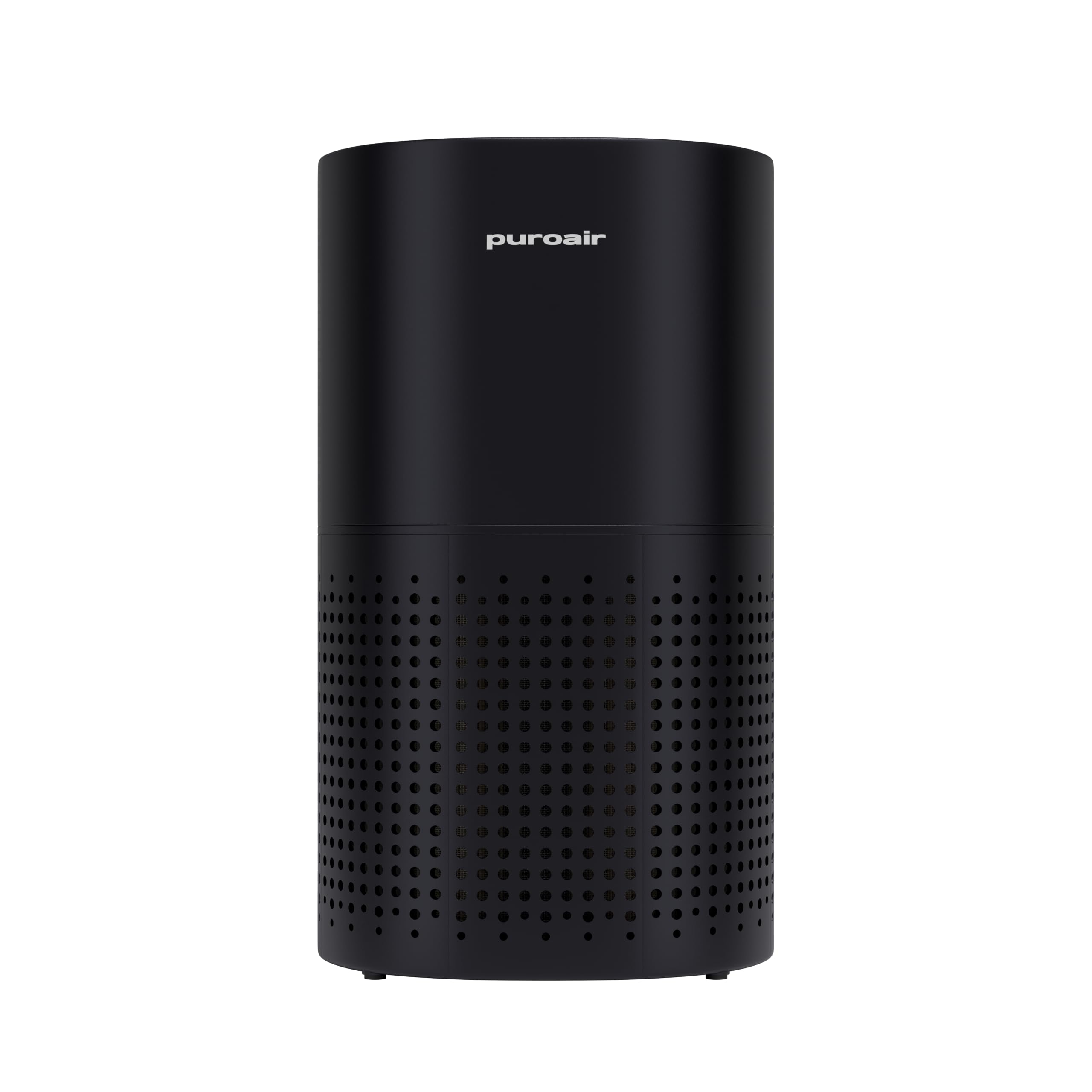
PIQSY verdict
PuroAir 240 (1,000 sq ft)
The independent room recommendation described in the manuscript is substantially smaller than PuroAir's advertised maximum area.
US modelPuroAir 240 (1,000 sq ft)
Best fit
- Modest enclosed rooms
- Buyers who check testing
Skip if
- You expect whole-home performance
- You equate one-hour coverage with high turnover
Biggest reason to buy
In a suitably small room, particle filtration can still be useful when consistently operated.
Main compromise
Its one-hour marketing-area claim is not equivalent to several complete air changes per hour.
Last checked price
$159.99
Amazon rating
★ 4.5 · 19,937 ratings
Amazon.com snapshot · Nov 3, 2026
Paid link · PIQSY may earn a commission
Some shopping links may pay PIQSY a commission if you make a qualifying purchase. Editorial assessments remain independent. Affiliate disclosure
What matters
Why it earns consideration — and why you might skip it.
Decision snapshot
Choose it for
Consider the PuroAir 240 for a contained bedroom, study or small living space where compact placement matters and where you are willing to confirm performance expectations against more than a marketing headline.
Know before buying
The Levoit Core 300-P is a relevant small-bedroom alternative with a manufacturer-reported 143 CFM CADR and a 222-square-foot reference at 4.8 ACH.
The PuroAir 240 is the air purifier to consider only after checking what its big room-coverage promise actually means. PuroAir advertises a capability to clean the air in a space of up to 1,000 square feet in one hour. That does not mean the machine can deliver several equivalent air changes each hour in a 1,000-square-foot living space. An independent test of a PuroAir 240 reached a substantially more modest room recommendation, illustrating why the difference in methods matters.
A separate RTINGS review reports 92 CFM of measured PM1 clean-air delivery at maximum speed in its test and a 144-square-foot recommended room size under its own sizing method. Those results are not a manufacturer AHAM smoke CADR, nor are they two measurements designed to be placed directly alongside PuroAir's one-hour claim. The takeaway is that you should evaluate this as a smaller-room candidate rather than assume it can provide high-rate cleaning across a large open home.
Who it fits
Consider the PuroAir 240 for a contained bedroom, study or small living space where compact placement matters and where you are willing to confirm performance expectations against more than a marketing headline. For a modest room, a smaller machine can be perfectly reasonable, particularly if it is easy to position and you are prepared to run it consistently.
If you are attracted by the phrase “1,000 square feet,” stop and measure your actual space. A modern open-plan living area, with a kitchen and hallway joined to the seating zone, may be much larger in air volume than it first appears. Ceiling height matters too. A purifier does not treat square feet on the floor; it moves air through its filters.
A sensible buyer starts from the amount of clean air required for the room and the speed at which the purifier can deliver it while remaining tolerable to use. The PuroAir 240 may be appropriate in some smaller rooms, but it should not be presented as a whole-home solution on the strength of a one-hour marketing phrase.
What changes the decision
“In one hour” is not the same as high-frequency air cleaning
The company describes coverage of up to 1,000 square feet in an hour, but the statement does not establish the same air turnover as a room-size figure based on 4.8 air changes per hour. Those assumptions are not interchangeable. A large area number can look dramatic when presented without an equivalent airflow rate or a matched room-height assumption.
Air changes per hour, or ACH, expresses how many room volumes of equivalent clean air are delivered each hour. If you want the air in an occupied room processed repeatedly, the target ACH helps you compare machine capacity more meaningfully than the largest printed square-foot number. To estimate this, you need room volume, not only floor area.
This is also why you should be wary of rankings that compare PuroAir's 1,000-square-foot claim with another brand's 300-square-foot figure at nearly five ACH and declare PuroAir more powerful. The underlying conditions are fundamentally different, so that comparison cannot support the conclusion.
The independent review offers an important reality check
RTINGS tested a PuroAir 240 using its own PM1 particle methodology. Its reported maximum-speed 92 CFM result and 144-square-foot recommended room size are far more modest than the manufacturer's 1,000-square-foot marketing statement might lead shoppers to expect.
These two sources should not be blended into a single universal performance statistic. The manufacturer is making a time-based coverage claim, while the reviewer is measuring clean-air delivery under a different procedure and using its own room recommendation. That difference is precisely why evidence has to retain its method and conditions.
The tested physical model was identified as a PuroAir 240. The existing US marketplace research also contains a direct model-and-UPC observation, but the precise manufacturer-to-retailer configuration has not received final independent cross-signoff. The safest interpretation is that the review is a useful model-level performance reference, not a promise for every retail bundle, accessory choice or operating mode.
If your room is close to the independent recommendation, the product may merit more consideration. If it is many times larger, the measured performance gives you a strong reason to explore a higher-airflow option before checkout.
High speed and quiet speed serve different purposes
The maximum-speed performance is particularly relevant because a room-size claim can be misleading if a shopper intends to operate the purifier only in a quieter mode. Fan noise tends to rise as air movement increases. When the device is set lower for sleeping or watching TV, it will generally move less air each minute.
RTINGS' existing review also contains a separate airflow observation under a noise threshold. That is measured under the reviewer's own test conditions, not a universal guarantee of quiet-room performance. You should not use a maximum-speed result to claim equally strong cleaning at the quietest setting.
Picture running the PuroAir next to your bed. If you'd immediately turn the fan down, a maximum-speed test won't tell you whether the machine delivers enough cleaned air through the night. An appropriately larger machine that can operate more comfortably at a moderate speed may suit you better. Confirm comparable noise-at-airflow information before claiming a particular pair's winner.
Filter supply can outweigh a tempting purchase price
We haven't verified the current price of an original replacement filter, the replacement schedule for the exact US package or a dependable annual running cost. Before buying, find the genuine filter and price out the routine you'd actually follow. Don't assume the attractive initial device price tells the whole ownership story.
Find the genuine replacement filter specified for the PuroAir 240 and read its care instructions. Check how often it needs replacement in your conditions and what a present-day US seller actually charges. Add electricity consumption, filter replacement and any shipping costs when comparing a few years of ownership.
PuroAir's manufacturer FAQ records a 45-watt power specification and 120-volt operation. The wattage is a model-level rating, not an observed constant draw over every speed and hour. A hypothetical device running continuously at 45 watts would consume about 394 kilowatt-hours over one year; actual use could be substantially different. Electricity is only one part of its total operating expense.
Positioning and ventilation still matter
Even a correctly sized purifier needs unobstructed intake and outlet airflow. A machine behind a couch or inside a cramped shelf may circulate less effectively through an occupied room. Keep it where clean air can mix with the room, follow placement clearances and avoid blocking its air path.
The product's particle filtering does not prove complete removal of fumes, chemical gases, or odors. Carbon-containing layers can have some use with certain smells, but their performance depends on filter composition and contaminant load. Persistent kitchen emissions, moisture, smoke and chemical sources require direct control and appropriate ventilation.
A purifier may help reduce airborne particles while it runs; that is different from guaranteeing relief of allergy symptoms or preventing infections. Avoid buying any product on a broad health promise when the relevant supporting tests are about particle airflow.
Reviews and pricing should not decide this by guesswork
We don't have enough verified owner feedback for the exact US version to judge recurring problems or long-term satisfaction. That doesn't mean the purifier is unreliable—or a bargain. Check the current seller offer and weigh the independently reported small-room performance against the room you need to clean.
The more useful buyer questions are whether the actual unit matches the model tested, whether the filter is available, and whether its independently assessed capacity is right for the space. Current seller terms and return conditions should be checked at the time of purchase.
Owner views
Owner feedback still developing
Owner feedback is still developing, so PIQSY is not presenting a consensus yet.
Who should choose something else
The Levoit Core 300-P is a relevant small-bedroom alternative with a manufacturer-reported 143 CFM CADR and a 222-square-foot reference at 4.8 ACH. These figures follow a different source and rating method from RTINGS' PuroAir 240 measurement, so a numeric comparison needs that caveat, but the Levoit is worth investigating for a more clearly specified manufacturer room role.
For compact connected operation, the Levoit Core 200S-P has a 90 CFM manufacturer CADR and a 140-square-foot, 4.8-ACH reference. Do not declare these models equivalent based on those superficially similar numbers; they come from different methods and operating contexts.
For a medium or large room, look at the Coway Airmega Mighty AP-1512HH, Levoit Core 400S-P or another appropriately sized model with clearer capacity evidence. A larger appliance makes sense when the actual volume and air-change target justify it, not simply because the PuroAir box has a large number.
PIQSY conclusion
The PuroAir 240 is not necessarily the wrong product for a small space. The issue is the gap between a 1,000-square-foot, one-hour marketing statement and the much smaller 144-square-foot independent room recommendation tied to RTINGS' test method.
Consider it only after sizing your room using a realistic turnover target and checking the precise seller model and filter. Skip it for a large living area if you were relying on the 1,000-square-foot headline to establish strong repeated particle cleaning. The independent evidence supports caution—not a universal declaration that the purifier is ineffective.
Technical detail
Specifications
See full specifications
| Product | PuroAir 240 (1,000 sq ft) |
|---|---|
| US model | PuroAir 240 (1,000 sq ft) |
| Product Dimensions | 10.63 x 10.63 x 28 inches; 7.3 pounds |
| Item model number | PuroAir 240 |
| Date First Available | September 30, 2021 |
| Manufacturer | PuroAir |
| Power Source | ac |
| Control Method | Push Button |
| Filter Type | HEPA |
| Floor Area | 1000 square_feet |
| Noise Level | 22 db |
| Particle Retention Size | 0.1 micron |
| Controller Type | Button Control |
| Wattage | 22 watts |
| Contaminant Filtration Capability | Cigarette Smoke, Dust, Odors, Pet Dander, Pet Hair, Pollen, Volatile Organic Compounds (VOCs), Wildfire Smoke |
| Special Features | Automatic Air Quality Sensor and Indicator, Child Safety Lock, Filter Replacement Indicator, Quiet Sleep Mode, Timer |
| Filter Class | HEPA |
| Software Update Supported to Date | unknown |
| Brand Name | PuroAir |
| Model Number | PuroAir 240 |
| Model Name | Puro Air 240 |
| UPC | 659436451964 |
| Number of Packs | 1 |
| Edition | 240 |
| Item Highlight | Certified HEPA + CarbonTech™ Air Filter for Smoke, Odor, Allergies - PuroIQ Sensor Auto-Mode, Quiet Sleep-Mode, 360° Intake |
| Model Series | 240 |
| Unit Count | 1 Count |
| Warranty Description | 2 Year Manufacturer Warranty |
| Included Components | 2 Year Manufacturer Warranty, PuroAir 240 HEPA Air Filter, PuroAir 240 HEPA Air Purifier |
| Part Number | PuroAir 240 |
| Item Dimensions D x W x H | 8.5"D x 8.5"W x 14.25"H |
| Item Weight | 7.3 pounds |
| Color | Black |
Amazon.com technical listing observed Nov 3, 2026. Confirm exact configuration with the manufacturer.
Final decision
Ready to choose, or want one more check?
Buying options
Check the current offer.
Amazon.com · Checked Nov 3, 2026
Paid link · PIQSY may earn a commission
Our research approach
How to interpret the product details.
Our research approach
How to interpret the product details.